
Steam Frame Reaches 4.13% of Steam VR Headsets
Valve's October survey gives Steam Frame 4.13% of Steam VR headsets, while the queue-only device explains only about one-sixth of overall VR growth.
By Alex Reeves
· 3 min read · Source: VR.org News
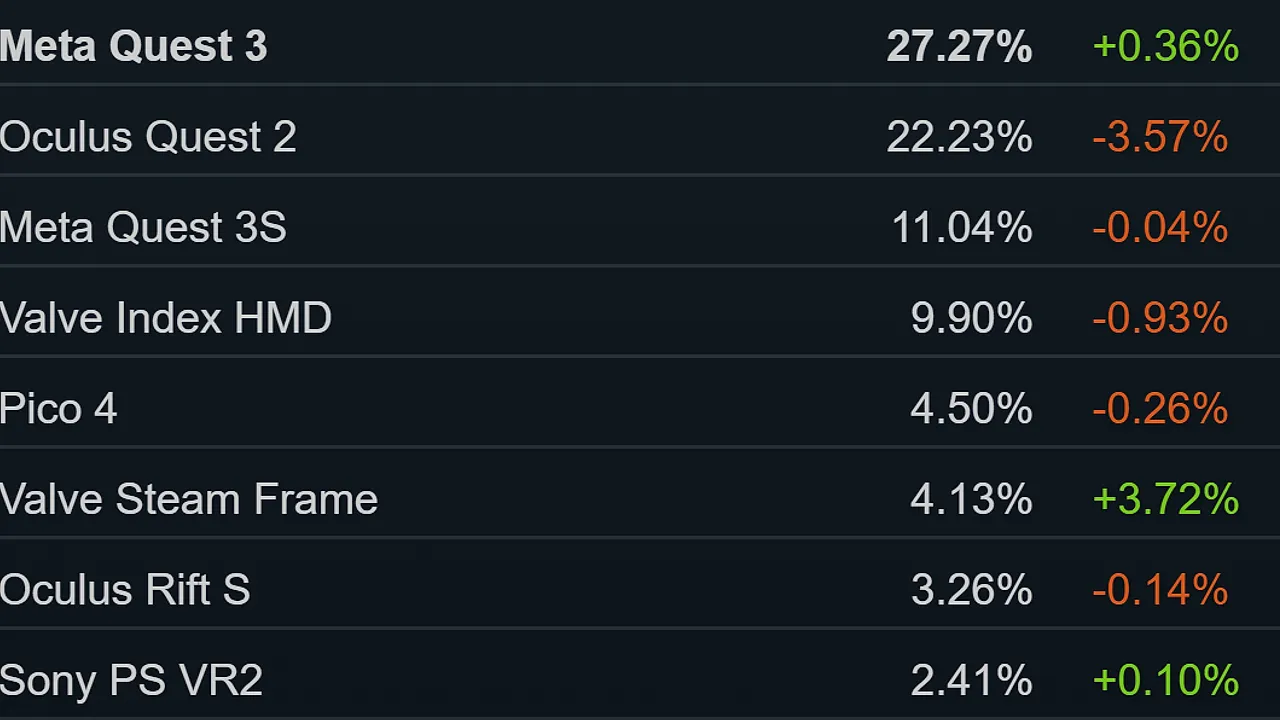
Steam Frame reached 4.13 percent of connected VR headsets on Steam in October, or about one in 24, during its first full month on sale. Valve still sells it through a reservation queue.
Valve's hardware survey asks Steam users once a month what hardware they have connected. Responses are optional and anonymous. The October result rose from 0.41 percent in September, when the device had been on sale for 13 days; October covered all 31 days. The survey is not a sales report, and Valve does not publish Steam Frame sales figures.
Access remained limited. Purchase emails began September 18. On October 9, Valve said reservation holders would receive their order email “by December, or in 2027.” The waitlist itself has no date.
The increase was 3.72 percentage points, about ten times Quest 3's 0.36-point gain. Steam Frame now ranks sixth among named headset rows, 0.37 points behind Pico 4. Six HTC rows combined reach 3.83 percent, so Steam Frame alone exceeds their total.
Steam Frame explains only part of VR growth
Steam's overall VR-headset share rose from 1.35 percent in September to 1.75 percent in October. That is the highest reading since January's 1.77 percent. The simultaneous appearance of a new Valve headset and a larger VR share looks connected, but the figures show that Steam Frame explains only a small part of the change.
Steam Frame's 4.13 percent share of the 1.75 percent VR total equals about 0.07 percent of all surveyed Steam users, or roughly one in 1,400. In September, the comparable figure was one in 18,000. The device therefore added about 0.07 percentage points to Steam's overall VR share, only one-sixth of the 0.40-point increase.
Survey composition appears to matter more. Simplified Chinese users fell 9.41 points in October, to 21.98 percent, after reaching 31.39 percent in September. English rose 4.84 points to 39.04 percent. Valve publishes no VR figure by language, but the two lines move against each other: VR's share changed in eight of the first ten months of 2026, and all eight movements went opposite to Simplified Chinese.
February shows the strongest example. Simplified Chinese reached 54.60 percent while VR fell to 1.05 percent. Language is only a proxy, and Valve does not explain these swings.
July offers a closer comparison. Simplified Chinese represented 22.52 percent, near October's 21.98 percent, while VR stood at 1.71 percent compared with October's 1.75. That is a 0.04-point VR increase across three months, smaller than Steam Frame's contribution alone. March and May also had Simplified Chinese shares near 22 percent, and both recorded 1.59 percent VR.
Quest 2 shows why headset-row changes need context. Its VR-headset share reached 22.09 percent in April, 26.97 percent in August and 22.23 percent in October. A six-year-old headset is unlikely to gain almost five points in four months and return them in two. Although Quest 2 fell 3.57 points within the October headset table, its share of all surveyed users rose from about 0.35 percent to 0.39 percent.
Unexplained survey rows
The “Other” row rose 1.27 points to 2.76 percent, the table's second-largest gain and a larger figure than the PS VR2 row. In September, more than half of that bucket's first-published gain was later identified as Steam Frame before Valve gave the headset its own row. Valve has not said what the bucket contains now.
Valve's Linux list also gained a new “SteamOS 64 bit” row in October. It represented 0.32 percent of all surveyed users; September's table had no such line. The row appeared beside SteamOS Holo at 0.55 percent.
Steam Frame runs SteamOS, as does Steam Machine, which shipped June 30. SteamOS 64 bit's 0.32 percent is more than four times Steam Frame's 0.07 percent share of all surveyed users. Steam Frame therefore cannot account for that row alone if both rows count users the same way. Valve's page does not explain what the row measures or whether a Frame used away from a PC is included.
What the figures mean for buyers and developers
Quest 3 and Quest 2 together represented 49.50 percent of connected headsets in October, down from 52.70 percent in September. PC VR studios will continue tuning for those two large installed bases first. The survey does not show VR on Steam growing 30 percent in one month, even though 1.35 percent rising to 1.75 percent can be read that way without context.
A reservation still means an order email by December or in 2027. A waitlist position still has no date. The audience for a $1,059 Steam Frame has grown to about one headset in 24 among connected Steam VR headsets. Whether that installed base justifies developer support will depend on the games, not on the headline increase alone.
Enjoyed this story?
Like it to tell the editors, or save it to read later.

Comments
Sign in to join the conversation.
Sign inNo comments yet. Start the conversation.
·