
PICO Space Program Sets Unequal AI App Prizes
PICO Space Program offers $50,000 across Android and Unity tracks, with registrations open until February 1, 2027, and finalists presenting in Silicon Valley.
By vrBlogs
· 4 min read · Source: VR.org News
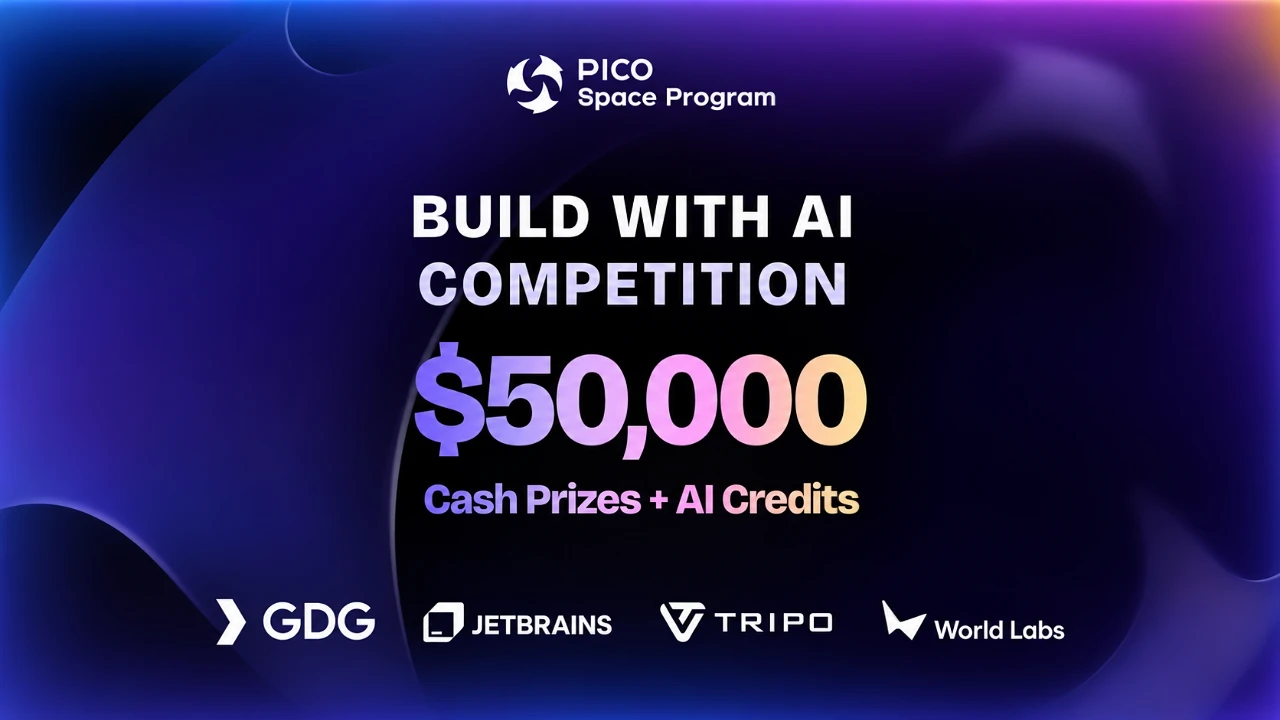
PICO Space Program is a $50,000 competition for spatial apps built with Android Studio, Unity or AI agents paired with the PICO CLI. Registrations opened on November 18, 2026, and submissions close on February 1, 2027, at noon Pacific time. Selected finalists will present in Silicon Valley.
According to the official PICO Space Program site, applications opened at 6:00 a.m. Pacific on November 18. The program's kickoff celebration is scheduled for November 24 at 10:00 a.m. Pacific. Developers can use Claude Code, OpenAI Codex, Cursor, GitHub Copilot or another AI agent they already use, paired with the PICO CLI.
Two development tracks, different top prizes
The competition has an Android track and a Unity track. Track A covers native Android development in Kotlin with Android Studio and the PICO Spatial SDK. Track B uses Unity and C#.
The Android track pays $10,000 for Best Android Track Submission and $5,000 to its runner-up. The Unity track pays $5,000 for Best Unity Track Submission and $2,000 to its runner-up. Third through tenth place in each track receives $1,000, creating eight prizes per track at those positions. The two tracks therefore match from third place through tenth place but differ at the top.
Four additional categories each pay $1,500 to a winner and $1,000 to a runner-up: Best Use of Frontier Models, Best Use of Agentic Workflow, Best Mobile App Port and Best XR App Port. Most Viral on Social has four $500 winners. That award requires a public post tagging PICO with the program hashtag.
The program advertises $50,000 spread across 32 cash prizes. The official site says selected finalists will fly to San Jose for a live presentation in Silicon Valley. The top 20 finalists are flown to the finale, and travel is available to finalists based in North America and Europe. Developers can test with the PICO Emulator, so a headset is not required.
AI-assisted setup targets PICO OS 6
The official landing page provides separate prompts for the Android and Unity tracks. The native prompt tells an agent to fetch and follow the complete Kotlin setup instructions for PICO OS 6. The Unity prompt directs agents to the Unity setup instructions for the same operating system.
The native document is revision 2026-10-08. It tells an agent to query public npm metadata for the newest stable @picoxr/pico-cli instead of pinning a version, install a Node LTS build if none is present, and resolve Android Studio against the current Spatial plugin's documented compatibility range.
It also directs the agent to install the Android platforms and sources required by the current template. The previous template required platform and sources 35. The setup provisions a dedicated PICO Emulator device and ends with an interactive solar system visibly running on that emulator as a smoke test.
The landing page describes the workflow as moving from a prompt to a Kotlin app or an XR app. Tutorials start from zero, with office hours, idea validation and team formation before final polishing and submission.
Competition branding and administration
The competition is presented under PICO branding, but the legal and administrative roles are narrower. The landing page states, “XR Bootcamp GmbH is the sole sponsor of the competition.” The official rules on Devpost name XR Bootcamp GmbH of Potsdam as sponsor and administrator.
The rules describe Pico Immersive Pte. Ltd. as “the brand and hardware/software partner of the PICO Space Program.” They also state that PICO is not the sponsor or administrator of the Hackathon, including judging and prize fulfillment. XR Bootcamp describes itself as a global online academy for XR development courses.
According to the program terms, all prizes are awarded and paid by XR Bootcamp GmbH. The terms say program partners support the program with prizes, tools, mentoring or promotion, without identifying which partner provides each contribution. PICO supplies the brand, toolchain and hardware at the finale. Devpost lists six judges, including two ByteDance employees.
How the program fits wider XR tooling
VR.org News reported that XR platform holders spent 2026 connecting software development tools with coding agents. Google connected Gemini to its XR Blocks framework in March. Meta added an agentic workflow to its WebXR SDK in April. ByteDance's PICO published an Apache-2.0 plugin marketplace for coding assistants in June, and it covered ten assistant hosts by late September.
Meta's $1 million VR Start competition closed on the day PICO's competition opened. That program asked entrants to speed development with Meta's AI tooling and offered a $25,000 Best Agentic Interaction award for apps with AI at their core.
VR.org News reported on November 21 that PICO's competition instead places coding-agent use inside a $50,000 prize pool with a February deadline. Its report also noted that the spatial tooling read in October was Apache-2.0, aimed at PICO OS 6 and the Spatial SDK, while the Unity side was a 0.1.1 package relying on a Unity AI Assistant release that Unity has only shipped as a preview. The Android first prize being twice the Unity first prize gives that difference a clear place in the competition's award structure.
The competition's entry path begins with copying a prompt into an existing coding agent. Developers may choose Android Studio and Kotlin, Unity and C#, or an agent paired with the PICO CLI, then submit work for consideration before the February 1 deadline.
Enjoyed this story?
Like it to tell the editors, or save it to read later.
Comments
Sign in to join the conversation.
Sign inNo comments yet. Start the conversation.
·