
KAT Walk C3 Ultra Review: Setup, Space and VR Walking
An early KAT Walk C3 Ultra review covers setup, room requirements, tracking, movement, PC VR support, editions and hands-on limits before launch.
By Skarredghost
· 7 min read · Source: The Ghost Howls
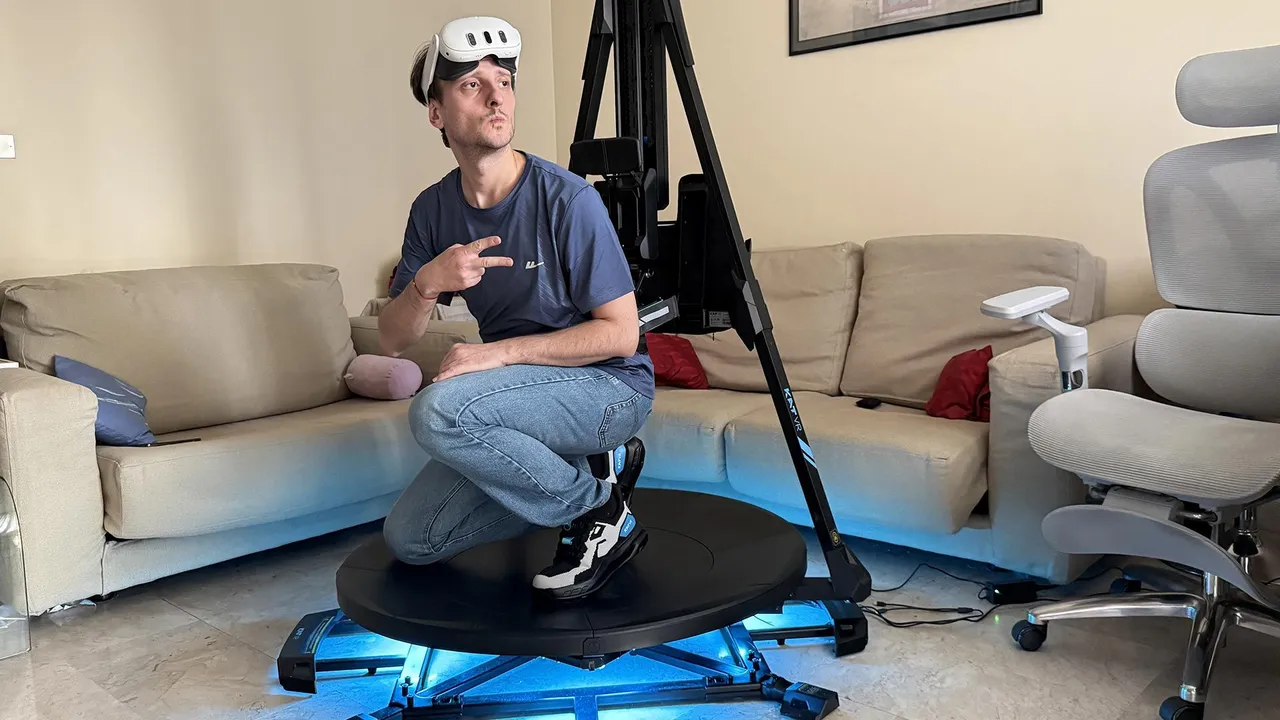
KAT Walk C3 Ultra is a VR treadmill that turns physical walking into smooth-locomotion input for VR games. This early hands-on review covers its preview hardware, setup, room requirements, movement system and practical limits before the official announcement.
KAT VR provided the review unit. It was a preview device, so commercial hardware may have small differences, and the software could receive improvements in the following weeks.
What KAT Walk C3 Ultra does
The KAT Walk C3 Ultra uses a concave platform, a rotating harness and dedicated shoes. Sensors in the shoe soles detect movement. The treadmill sends that data to a computer, where software translates walking into the thumbstick input used for smooth locomotion in VR.
The system supports forward walking, lateral strafing and backward movement. It is theoretically compatible with every VR game that supports smooth locomotion, while teleport-only or otherwise unsupported movement systems may not work. KAT VR has built several devices in this category and describes itself as one of the field's world leaders.
The company's stated aim is a more realistic sensation of walking in virtual reality. The reviewer was initially doubtful of marketing claims calling it “The first VR treadmill that does it all: most immersive, fully omnidirectional, longest-enduring,” but found the device fun to use despite never being a major fan of VR treadmills.

Delivery and room requirements
The review unit arrived on a 70kg (154 pounds) pallet. That delivery weight gives a practical warning: this is a large, heavy device. Moving it upstairs requires help, and assembling it requires both space and physical effort.
The treadmill occupies approximately 1.5m x 1.5m (5 feet x 5 feet). The reviewer had to move tables and a carpet and place it in the middle of the living room. Buyers should plan its location before ordering. A gaming room may suit it better than a shared living space, but the floor area remains necessary either way.
The logistics are manageable with help, but they are part of the purchase decision. The device is not a compact accessory that can be placed in any unused corner.
Unboxing the treadmill
The KAT Walk C3 Ultra arrived in four boxes: two relatively small and two large. It was disassembled into many parts rather than shipped as one platform and one harness. Even the concave platform consisted of roughly five pieces, alongside the parts needed to build its supporting structure.

The packaging was standard rather than remarkable. Components were arranged neatly and protected with substantial foam. Screws and smaller parts came in plastic bags. The experience resembled unboxing IKEA furniture, and removing everything from the boxes required plenty of open floor space.
Assembly takes time
The reviewer expected to assemble the main pieces in about 20 minutes. The number of smaller components changed that expectation, but the assembly itself was not difficult once the instructions were understood. KAT includes screws, screwdrivers and spare screws.

Both paper instructions and an instruction video are available. The reviewer used the written instructions and checked the video when uncertain. One paper identifies the components with names and pictures; the other explains the assembly steps. Using both together makes it easier to match names such as “Extension bar” and “Back Part” with the correct pieces.


Assembly took around 1 and a half hours. The required working area was around 2.5m x 2m (8.2 ft x 6.6 ft), including space for the treadmill and room to prepare parts on the floor. The work required physical effort, including lifting a 13kg (28 pounds) component. The reviewer finished tired and sweating, but the treadmill was ready.

PC connection and first setup
The treadmill needs power and a USB connection to a computer. The review unit used a Chinese plug; the official version was expected to offer more international options. The computer must be close enough to the KAT Walk unless an extender cable is used.

Setup uses KAT Gateway, KAT's installation program. The reviewer first created an account, then started pairing. KAT Gateway identified the treadmill automatically. The shoe sensors must be associated one at a time. Pairing both at once caused problems during the reviewer's installation.

After pairing, the sensors go inside the shoe soles. The initial configuration was quick and straightforward. It only needs to be completed once: on later use, including after several days, turning on the system was enough. The treadmill and shoe sensors did not need to be paired again unless a problem occurred.
Build and appearance
The treadmill felt solid and well made. Its materials appeared good, and the rotating harness moved smoothly with almost no friction or noise. Black panels with light-blue finishes suited a tech-gaming room. A blue-white light on the bottom made the device more visible at night.

The reviewer expected cheaper construction and was pleasantly surprised by the result. The main design concern was placement in a living room, where the treadmill did not match the rest of the space. In a dedicated gaming room, it could fit more naturally.
How walking input works
The large platform mainly provides a surface for walking. The shoes perform the actual walking detection. Their soles contain openings for sensors that measure movement speed; the floor itself has no walking sensor.

The shoes connect to the platform through Bluetooth and send their data to it. The platform passes that data to the host computer over USB. KAT software uses an algorithm to determine whether the user is walking in a direction, then sends the input to SteamVR. Forward walking becomes a smooth-locomotion command, usually equivalent to moving the thumbstick forward. Lateral and backward movement are also supported.
The device works with SteamVR and can be used with Quest headsets through PC VR, wireless streaming or an optional Quest Adapter. Compatibility still depends on how each game handles movement. The review tested the treadmill with Gorn, Half-Life: Alyx and VRChat.
Movement and tracking limits
Walking on the system is not identical to walking on ordinary ground. The reviewer found safety and tracking limitations during onboarding, crouching, strafing, backward movement and precise short steps. These limits matter because movement that feels natural in a game may not be detected perfectly by the preview unit.

The treadmill aims to support omnidirectional movement, but users still need to learn how to position their feet and control their pace. Entering, exiting, crouching and changing direction require care. The reviewer also noted that slippery shoes can affect control and safety, so users should follow the provided guidance rather than treat the platform like a normal floor.

The reviewer's experience is evidence from one preview unit, not a guarantee that every game or final commercial device will behave identically. KAT VR could improve the software before release, and commercial hardware may differ from the unit supplied for testing.
Versions and pricing
KAT Walk C3 Ultra has Standard and Power editions. The review lists the Standard Edition at $1,499 with shoes and the Power Edition at $1,699 with shoes. The Power Edition adds built-in headset charging.
The official KAT VR store later listed the Standard Edition at $1,598 and the Power Edition at $1,798 before current promotional discounts. Its Black Friday Deals page listed promotional prices of $1,199 for Standard and $1,359 for Power. Prices and promotions can change, so the official KAT VR pricing page is the relevant reference for those offers.

The review was published on October 27, 2026, before KAT VR's official announcement and launch material. It is therefore an early preview rather than a final launch report. For product information and support details, see KAT VR's KAT Walk C support page.
The main practical questions are space, assembly and movement expectations. The KAT Walk C3 Ultra requires a roughly 1.5m x 1.5m footprint, around 1.5 hours of assembly and a PC-based setup, but its dedicated shoes, rotating harness and smooth-locomotion input make it a distinctive way to play compatible VR games.
Enjoyed this story?
Like it to tell the editors, or save it to read later.

Comments
Sign in to join the conversation.
Sign inNo comments yet. Start the conversation.
·