Apple says it is committed to visionOS, sets early 2027 for live immersive tools
At a Meet with Apple livestream, Apple said it remains committed to visionOS and laid out a live Apple Immersive production pipeline, with partner tools due early 2027 and no new Vision Pro hardware.

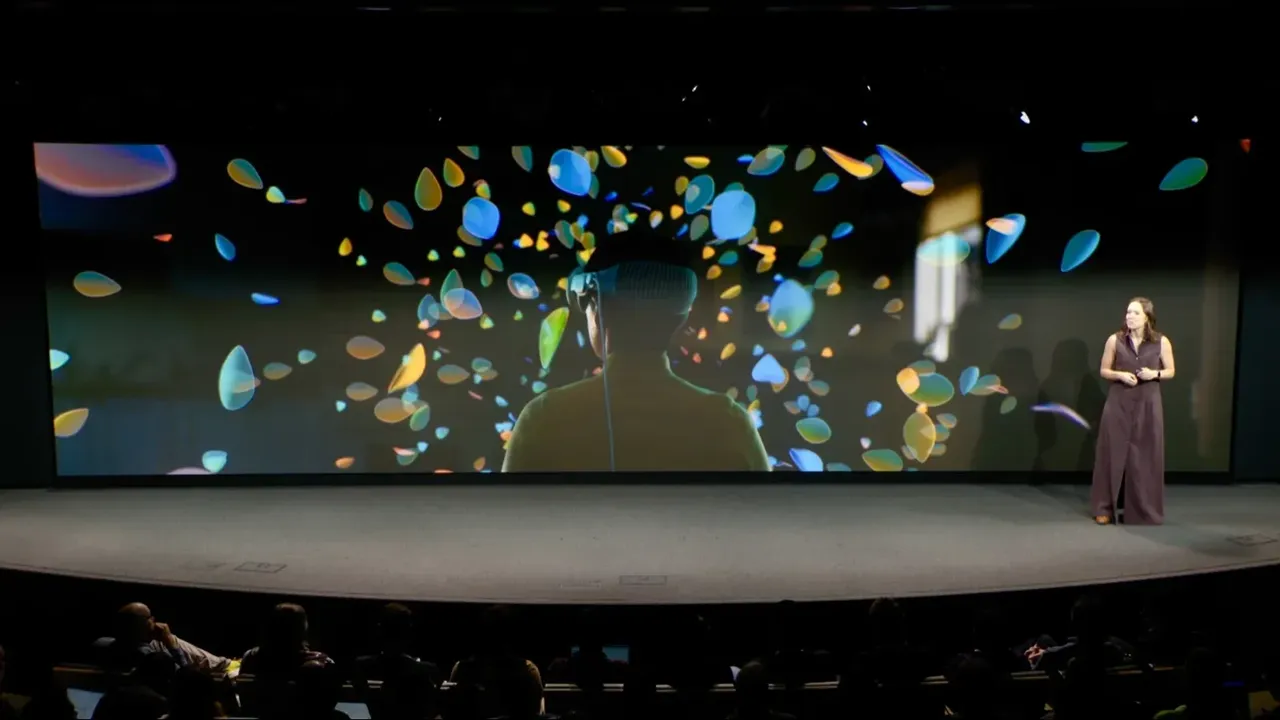
Apple used its November 11 developer livestream, Create immersive media experiences for spatial computing, to tell creators it is staying with visionOS. Asked by the host whether the company is committed to the platform, Yuri Imoto, a product manager in Apple's spatial computing group, answered that "Apple is committed to this platform." He pointed to surgery and healthcare, education, training and immersive film as the areas where the platform is gaining ground.
The session did not include any new Vision Pro hardware or a successor timeline. The current headset remains the M5 Vision Pro introduced in October 2025, and the commitment Apple voiced applies to the visionOS software platform.
The day-long event was streamed from Apple's developer center in Cupertino and is available as a replay in the Apple Developer video library. Most of the program covered the craft of immersive film, but the practical news for production teams was a clearer picture of live Apple Immersive broadcasts.
How Apple Immersive Live Video works
Apple first detailed the live format in a WWDC26 session, Build live production tools for Apple Immersive Video, and the November event walked creators through the full chain. The format has three parts:
- Video: streamed ProRes frames rather than the uncompressed frames typical of broadcast cameras. Left and right eye images travel as two essences inside one stream, with no frame packing.
- Audio: uncompressed PCM tracks carrying higher-order ambisonic beds and spatial audio objects in the Apple Spatial Audio Format, with mixes that can exceed 64 channels.
- Metadata: a JSON object attached to every frame, carrying lens calibration, creative events, motion data and spatial audio behavior.
Each part moves as its own SMPTE ST 2110 stream: ProRes over ST 2110-22, PCM audio over ST 2110-30 and the per-frame JSON over ST 2110-41. Because ST 2110 is already the IP standard in modern broadcast facilities, the format slots into existing infrastructure, although Apple notes that the picture is about 32 times the resolution of a typical 2D broadcast at twice the frame rate, which much current gear cannot carry. The stream is encoded to MV-HEVC for delivery to Vision Pro.
Since the video is ProRes end to end, recordings are written straight into MOV files and played back into the live chain without re-encoding. Apple's Immersive Media Support framework, AVFoundation and VideoToolbox handle the metadata, recording and playback steps on Apple silicon Macs.
Partner tools due early 2027
Apple has produced its live immersive broadcasts so far, including courtside Los Angeles Lakers games in the Spectrum SportsNet and NBA apps and a run of MLB games. During the livestream, Jared King, who leads Apple's live immersive engineering team, said partner tools will complete the whole chain in early 2027, so outside productions can build and run live immersive events on their own.
Companies named in the session include Blackmagic Design for cameras, switching, networking, recording and live Fairlight mixing; Softron for immersive instant replay; Vizrt for on-air graphics; Bridge Technologies for signal and format checks; and Cisco and Arista for facility networking. Apple did not give product names or dates for each partner beyond the early 2027 target.
Blackmagic Ambisonic Microphone ships in December
The first piece of new hardware for this workflow comes from Blackmagic Design. The Blackmagic Ambisonic Microphone packs 108 MEMS capsules into a metal sphere and encodes them inside the microphone to 64 channels of 7th-order ambisonic audio, which Blackmagic calls a world first. A single USB-C cable carries audio and power.
- Price: $1,909 with mount, or $2,405 for a kit that adds a windshield and a locking USB-C cable (US list prices on Blackmagic's product page).
- Availability: December 2026.
- Hosts: the microphone does not record by itself. It works with the URSA Cine Immersive camera, a computer running Fairlight Live, or an iPhone with the Blackmagic Camera app.
Blackmagic CEO Grant Petty said Apple licensed its array geometry and ambisonic encoding filters for the design, with Blackmagic handling the engineering. For Vision Pro creators, that means spatial audio captured at the camera position can be recorded in sync with Apple Immersive footage instead of being rebuilt in post.
Enjoyed this story?
Like it to tell the editors, or save it to read later.


Comments
Sign in to join the conversation.
Sign inNo comments yet. Start the conversation.
·