
KAIST-led team finds oxide that could make AR glasses' waveplates 120x thinner
KAIST, UNIST and Pusan National University researchers report that copper aluminum oxide could enable half-wave plates about 1/120 as thick as quartz ones. It is a crystal measurement, not a device yet.

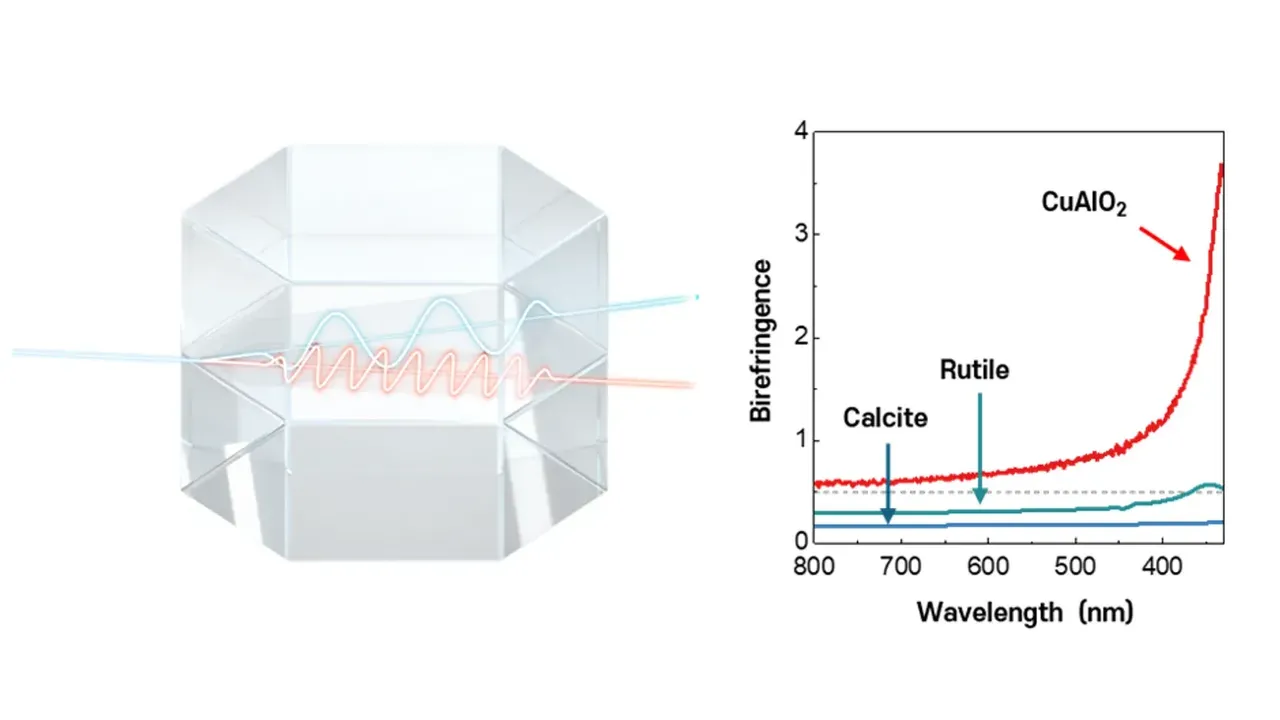
A team led by physicist Changhee Sohn at KAIST, working with researchers from UNIST and Pusan National University, says the oxide semiconductor copper aluminum oxide (CuAlO2) could let one class of optical parts used in smart glasses shrink to roughly 1/120 of today's thickness. KAIST announced the result on November 24, 2026. The underlying paper appeared in Nature Communications on October 13.
The part in question is not a lens or a waveguide but a polarization-control component: the half-wave plate, which rotates the polarization of light passing through it. The claim is about that one component, not about how thin a complete pair of AR glasses could become.
What the researchers measured
Half-wave plates work through birefringence, meaning a material's refractive index depends on the direction in which light oscillates. Light polarized one way travels slower than light polarized the other way, and the plate is made just thick enough to build up half a wavelength of delay. The stronger the birefringence, the thinner the plate can be for the same effect.
Crystalline quartz, a common waveplate material, has fairly weak birefringence. KAIST says a quartz half-wave plate for violet light must be about 52 times as thick as the wavelength of that light, roughly 20 micrometers.
CuAlO2, by contrast, shows about 120 times the birefringence of quartz for violet light while still transmitting visible light well. From that, the team estimates a CuAlO2 half-wave plate could be just 173 nanometers thick, thinner than the wavelength of the light it controls.
The paper, "Colossal visible birefringence and ultraviolet hyperbolicity in wide bandgap semiconductor CuAlO2," gives the details. Using spectroscopic ellipsometry on millimeter-sized single crystals, the authors report a maximum birefringence of 3.67, a value above 0.5 across the whole visible range, and a direct band gap of 3.71 eV. The wide band gap matters because materials with strong birefringence usually also absorb more light; the team argues CuAlO2 avoids much of that trade-off.
The researchers trace the effect to the crystal's linear O-Cu-O "dumbbell" units, which make one strong optical transition near 3.78 eV appear only for light polarized within the material's atomic layers. In the ultraviolet, the same transition makes CuAlO2 behave like a metal within those layers but not across them, a so-called hyperbolic response that KAIST says could be useful for future UV optical devices.
Why it matters for AR glasses
Smart glasses have to fit displays, optics, batteries, cameras and electronics into something close to normal eyewear, so every layer in the optical path counts. Polarization control is used across display and optics hardware, and a waveplate measured in nanometers instead of tens of micrometers could in principle become a thin film rather than a separate plate.
"We confirmed that optical components capable of transmitting light efficiently while controlling its polarization could be made with just 1/120 the thickness of conventional components," Sohn said in KAIST's announcement. "This could help make smart glasses and optical communication equipment smaller and lighter."
The realistic gain for a finished pair of glasses is smaller than the headline number suggests. Waveplates are only one element of an optical stack, and the rest of the device would not shrink with them.
How far this is from products
This is materials research at an early lab stage. The properties were measured on bulk single crystals, and the 173 nm figure is an estimate derived from those measurements. Neither KAIST nor the paper describes a working CuAlO2 half-wave plate, and the material has not been tested in any AR device.
KAIST says practical use depends on developing high-quality thin-film fabrication. "We are now working to fabricate thin, uniform films suitable for practical devices while further reducing optical loss," Sohn said. No industry partner, prototype or timeline was announced.
Baekjune Kang of KAIST and Junhee Shin of UNIST are co-first authors. Sohn, Hosub Jin of UNIST and Jong Mok Ok of Pusan National University are co-corresponding authors. The paper is available at doi.org/10.1038/s41467-026-78383-2.
Enjoyed this story?
Like it to tell the editors, or save it to read later.


Comments
Sign in to join the conversation.
Sign inNo comments yet. Start the conversation.
·